Smart Telecom Probe: Banking vs. Telecom Laws Collide
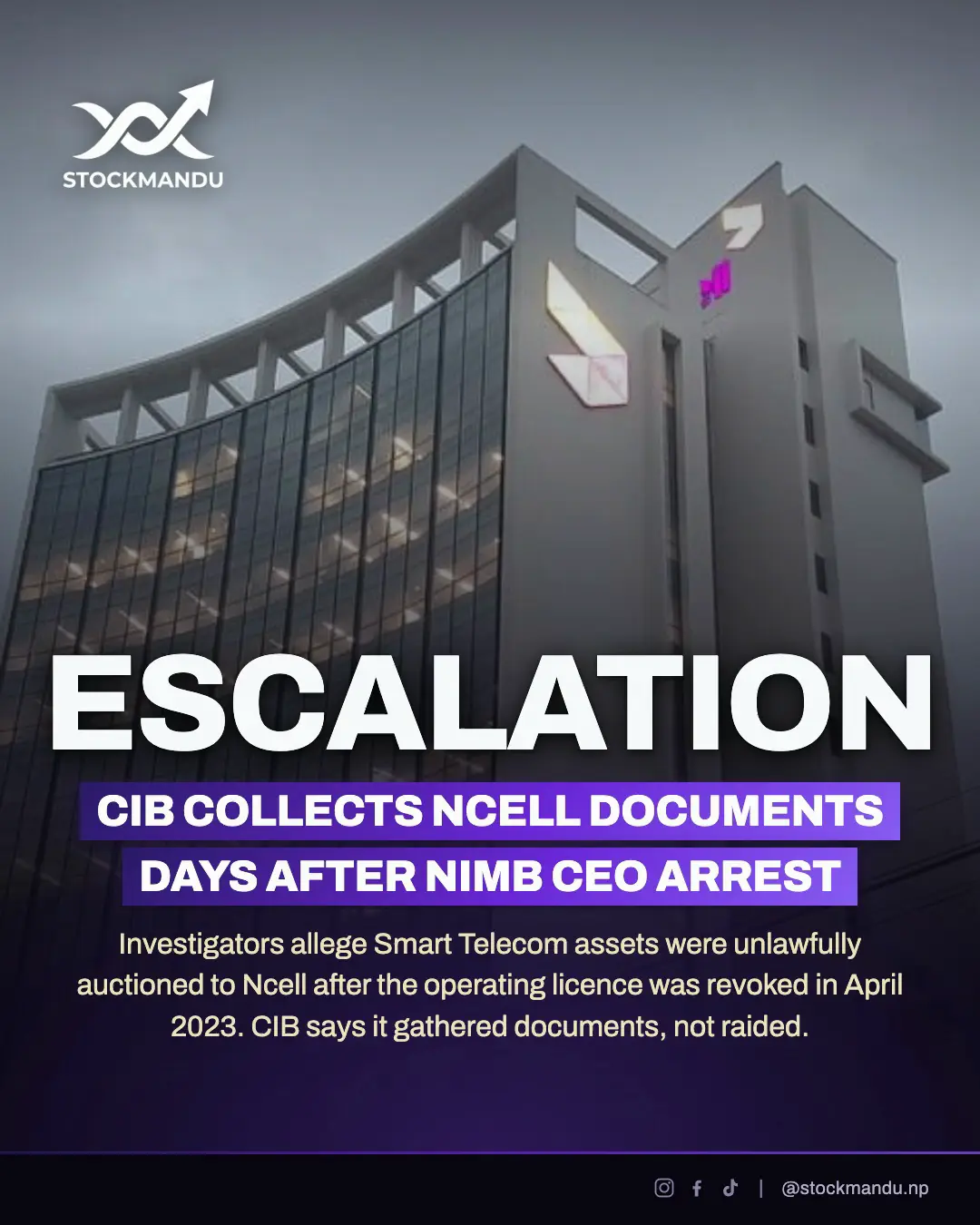
Executive Summary: The CIB’s widening Smart Telecom investigation has thrust Nepal’s lending laws and telecom regulations into conflict. After the April 2023 auto‑cancellation of Smart Telecom’s licence, its assets were declared state property. A 2025 auction by NIMB of those same assets – won by Ncell for Rs 4.6 billion – is now deemed illegal by investigators. This has led to the arrest of NIMB CEO Jyoti Pandey and CIB document seizures at Ncell (May 14 2026), raising big questions about who really owns distressed collateral in Nepal.
| Date | Event |
|---|---|
| Apr 16, 2023 | Smart Telecom licence auto‑cancelled for non‑renewal. NTA takes assets into state custody. |
| Sep 19, 2025 | NIMB issues public auction notice for Smart Telecom collateral. (Auction held Oct.) |
| Oct 6, 2025 | Auction: Ncell bids Rs 4.60 billion, wins Smart Telecom equipment. |
| May 4, 2026 | Ex‑SmartTel MD Sarvesh Joshi arrested in Smart assets probe. |
| May 12, 2026 | NIMB CEO Jyoti Pandey arrested by CIB for allegedly auctioning state property. |
| May 14, 2026 | CIB collects documents from Ncell’s head office over the Smart Telecom asset sale. |
| May 15, 2026 | Supreme Court grants Pandey bail, noting insufficient grounds for continued custody. |
Fact Summary & Timeline
Licence Revocation (Apr 2023): Smart Telecom’s unified licence automatically lapsed in April 2023 after the company failed to renew and clear large dues. Under Nepal’s Telecom Act and 2022 Asset Management Regulation, all its infrastructure then passed to the Nepal Telecommunications Authority (NTA) as state property. The NTA publicly announced in May 2023 that it had taken control of Smart Telecom’s assets, which included towers, network equipment and systems.
Loan Defaults and Auction (2023–2025): Smart Telecom owed over Rs 30 billion to the government (license fees and penalties) while borrowing roughly Rs 5.2 billion from a bank consortium led by NIMB. Its infrastructure was pledged as collateral under Nepal’s Secured Transactions Act. In late 2025 NIMB (acting on instructions to recover an NPL) auctioned the collateral. On 6 October 2025, Ncell which was the leading private operator won the auction with a Rs 4.6 billion bid. NIMB used the proceeds (≈Rs 4.22 billion) to retire its outstanding loan; the remaining ≈Rs 380 million was held back to cover SmartTel’s other debts.
CIB Investigations (2026): Investigators then widened their probe. In early May 2026, CIB agents arrested Sarvesh Joshi (ex‑SmartTel MD) and two associates. On 12 May, NIMB’s CEO Jyoti Prakash Pandey who chaired the loan recovery committee – was detained in Sindhuli on charges of fraud and criminal breach of trust for his role in the auction. Two days later, on 14 May, the CIB raided Ncell’s Kathmandu headquarters to copy documents related to the asset purchase. (Ncell has reportedly asked NIMB to refund its Rs 4.6 billion payment, saying regulatory issues prevent it from taking possession of the equipment.) The Supreme Court on 15 May granted Pandey bail, noting that investigators lacked sufficient grounds for continued detention.
Legal Issues
Collateral vs. State Claims: The central legal question is a clash of Nepal’s banking laws against its telecom regulations. Under the Banks and Financial Institutions Act (BAFIA) 2017 and the Secured Transactions Act 2006, banks have “first charge” rights on collateral and may auction pledged assets to recover loans. NIMB points out it followed these laws (with public notice and no court order blocking the sale).
By contrast, the Telecom Service Provider Asset Management Regulation, 2022 (promulgated by the NTA) says that when a licence is cancelled, all related telecom assets “become the property of the state”. In particular, Rule 18 of that 2022 regulation asserts NTA control over assets from cancelled companies. Investigators argue that SmartTel’s infrastructure had become state property by law in 2023, so the 2025 auction was effectively a sale of government-owned equipment – a “fraudulent” act under the criminal code.
Regulatory Conflict: Legal experts note a potential conflict: BAFIA explicitly empowers banks to auction collateral “notwithstanding anything contained in prevailing law”, while telecom law reassigns assets to the NTA. Critics argue the Asset Management Regulation may have overstepped the parent Telecom Act (1997), which only allows state takeover for majority‑foreign firms. Banks say if they lose their statutory first charge, investment in licensed sectors (telecom, hydropower, airlines) would dry up. The CIB has framed the case around criminal breach of trust and fraud, contending the auctionors knowingly transferred state property to Ncell.
Market Implications
For NIMB shareholders and Nepal’s banking sector, this saga raises governance and legal risk concerns. Analysts warn that if collateral enforcement can be “second-guessed” after the fact, banks may become highly cautious. Republica quotes a banker: “If banks are no longer allowed to auction collateral assets… [then] all banks could face similar consequences”. Nepali bankers stress that Section 57 of banking law protects their right to recover loans by auction, and that undermining that could “make future financing for infrastructure and large-scale projects far more difficult".
NIMB’s own stock could come under pressure due to the uncertainty. An official note: the bank has asserted the auction was “within the legal framework” and is cooperating with authorities. Foreign investors, who value legal predictability, will watch how the courts balance regulator power against secured creditor rights. Markets typically tolerate anti‑corruption drives, but penalizing routine loan recovery could spook capital. One Republica expert warned: if asset seizures do not honor creditor priority, “the entire project financing model could collapse”.
Company Positions
-
NIMB: The bank’s official statement (May 14, 2026) emphasises that it followed the Bank and Financial Institutions Act and the Secured Transactions Act. It noted the auction was publicly advertised in Sept 2025, proceeds were used to repay depositors’ loans, and residual funds have been frozen for rightful creditors. NIMB says operations remain normal and it is “cooperating with regulatory bodies”.
-
Ncell: The telecom firm, through a letter, has asked NIMB to either complete formal asset transfer or return the Rs 4.6 billion it paid. Ncell’s concern stems from NTA objections as it currently holds only the cash (Rs 380 million) in escrow from the sale. A FiscalNepal report notes Ncell cannot take possession “due to legal and regulatory issues” and the CIB probe is cited as the complication. Ncell is not accused of wrongdoing; it is cooperating as a third party bidder.
Authorities (CIB) have not alleged misconduct by Ncell itself; they seek only documents to verify how the transfer occurred. In short, neither Ncell nor NIMB is accused of any violation beyond the core auction issue.
Next Steps & Precedent
The Smart Telecom case is likely to become a legal landmark. Observers will watch:
- Court Proceedings: NIMB and SmartTel principals will face trial on fraud/breach charges. The key legal question – how BAFIA/secured‑transaction law interacts with telecom asset rules – may require appellate rulings. The May 15 Supreme Court bail order signals careful judicial scrutiny of due process.
- Regulator Statements: The NTA may comment on its asset management powers, and Nepal Rastra Bank (central bank) and the Nepal Bankers’ Association are already voicing concern over lending risks. Any clarifications or policy guidance on collateral enforcement would be important.
- Investor Reactions: Financial analysts and foreign investors will monitor NIMB’s share price and the bond market for the broader impact on Nepal’s credit environment. If senior bankers face legal peril for routine recoveries, capital costs in Nepal could rise.
- Precedent: Outside Nepal, this clash echoes disputes in other countries over state vs creditor claims. The outcome will set a precedent in Nepal for all concessions. As Republica notes, if the state takes assets without debt, future lenders in telecom, hydropower, aviation, etc. might demand higher risk premiums or avoid certain sectors.
In sum, the Smart Telecom probe transcends one auction or CEO. It has kicked off a high-stakes debate on the rule of law in Nepal’s economy. Investors will judge whether Nepal upholds contractual and secured‑creditor rights or allows regulatory interventions to override them without compensation.